Browsed by
Category: Uncategorized

breytingar // changes

breytingar // changes

þú hefur kannski tekið eftir því að þar er nokkrar verkefni á þessi vefsiðu nýlega sem er ekki um að landnamsöld. Það er viljandi. Ég hef nú þegar endurskoðað síðuna “um (about)” sem er til að útskýra breytingarnar hvað er ég að gera, en ég hélt að ég ætti að útskýra það hér líka.

Þegar ég byrjaði þessi vefsíðu, það var af einni meginástæðu: sem staðgengill fyrir þátttöku SCA í eigin persónu. Síðan þá hefur líf mitt breyst mikið og aðallega á góðan hátt. Ég hef grennst í áhugamálum mínum og rannsóknum og takmarka mig ekki lengur við landnámsöld, svo ég vil að þessi vefsíða endurspegli það.

Það sem þetta þýðir er að þú munt sjá efni sem er utan landnámstímabilsins (“víkinga”) hér sem og frá því tímabili. Ég ætla að merkja allt á viðeigandi hátt, svo að það líti ekki út fyrir að ég sé að setja inn efni frá 13. og 14. öld og halda því fram að það sé viðeigandi fyrir víkingatímann.

Ef þú vilt lesa meira um þetta, farðu og kíkja á endurskoðaða „um“ síðuna mína hérna.

In English…

You may have noticed that there are some projects on this website recently that are not about the settlement (“Viking”) era. This is intentional. I’ve already revised the “about” page to explain the changes and what I’m doing, but I thought I should explain it here as well.

When I started this website, it was for one main reason: as a substitute for in-person participation in the SCA. Since then my life has changed a lot and mostly in a good way. I’ve expanded my interests and research and no longer limit myself to the settlement era, so I want this website to reflect that.

What this means is that you will see material from outside the settlement period (“Viking era”) here as well as from that period. I’m going to label everything appropriately, so it doesn’t look like I’m posting 13th and 14th century stuff and claiming it’s Viking-era-appropriate.

If you want to read more about this, go check out my revised ‘about’ page here.

my weaving presentation

my weaving presentation

There’s a revision coming to the “about” page here sometime in the future (plus I’m sure I’ll post about the change as well), but for now, don’t be surprised if you see some posts about things that don’t quite fall under the “settlement era housewife” category. I’ll explain later.

In the meantime, I have a video to show you! In the fall semester of the 2021/2022 school year, I took a class on Icelandic Folktales. A really cool thing about the Icelandic Department at the University of Manitoba is that all of the non-language courses have it as an option (and a strong recommendation, really) of one of the two assignments being what they call a “free-play” project. This basically works out to “anything that you can think of that relates to the course, even tangentially, in whatever medium you like”, within reason of course. I had this giant project I’ve been working on for years, and I decided I wanted to do something related, so I took a portion of that project and ran with it… I even started working on it before I started the course, because I knew what I wanted to do, and had the summer beforehand to work on it.

I reused the project last week, to do a presentation for a gallery opening at the Icelandic Library at my university – https://vinlandtovalinor.com/symposia/ – It’s the “Creation Myths of the North”. And now I have the video available for you to watch here too!

næsta verkefni mitt: Skjoldehamn hetta // my next project: a Skojoldehamn hood

næsta verkefni mitt: Skjoldehamn hetta // my next project: a Skojoldehamn hood

Ég ætla að skrifa færslu um rannsóknir á þessu fatnaði, sem er byggt á raunverulegum fundi frá eyju í Noregi sem heitir Andøya, nálægt Skjoldehamn. Það fannst á líki sem fannst í mó og var grafið upp af bónda við að skera mó, og eftir margar tilraunir er talið að það hafi verið á milli 995 og 1029. Líkið var ákveðið kvenkyns og það eru 20-30% líkur á að hún hafi verið af samískum ættum. Þannig að þetta plagg er EKKI íslenskt, en það er mjög líklegt að það eigi “víkingatímann” við. Þarna endar hentugleikinn fyrir alla mína íslensku fókus, þar sem ég er að búa hann til úr efni sem eru aðeins óljóst nákvæm (þung ull úr teppi, fóðruð með silki og útsaumuð með ull) og í litum og með útsaumi sem er miklu meira fantasíuvíkingalegt en sögulegt.

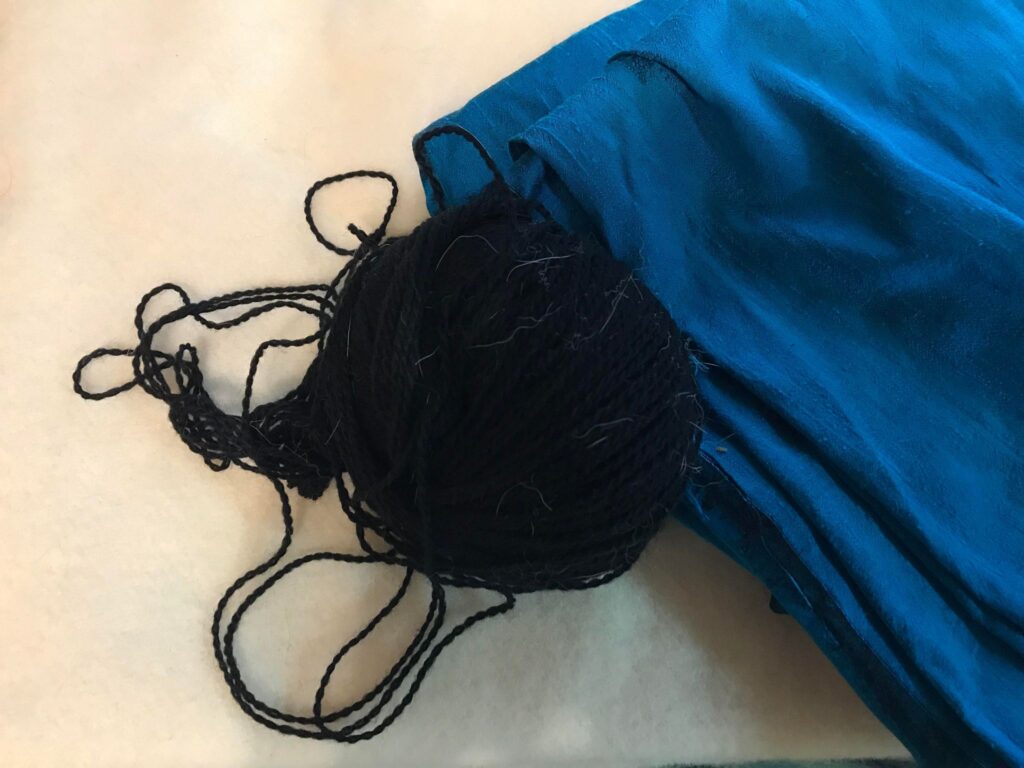
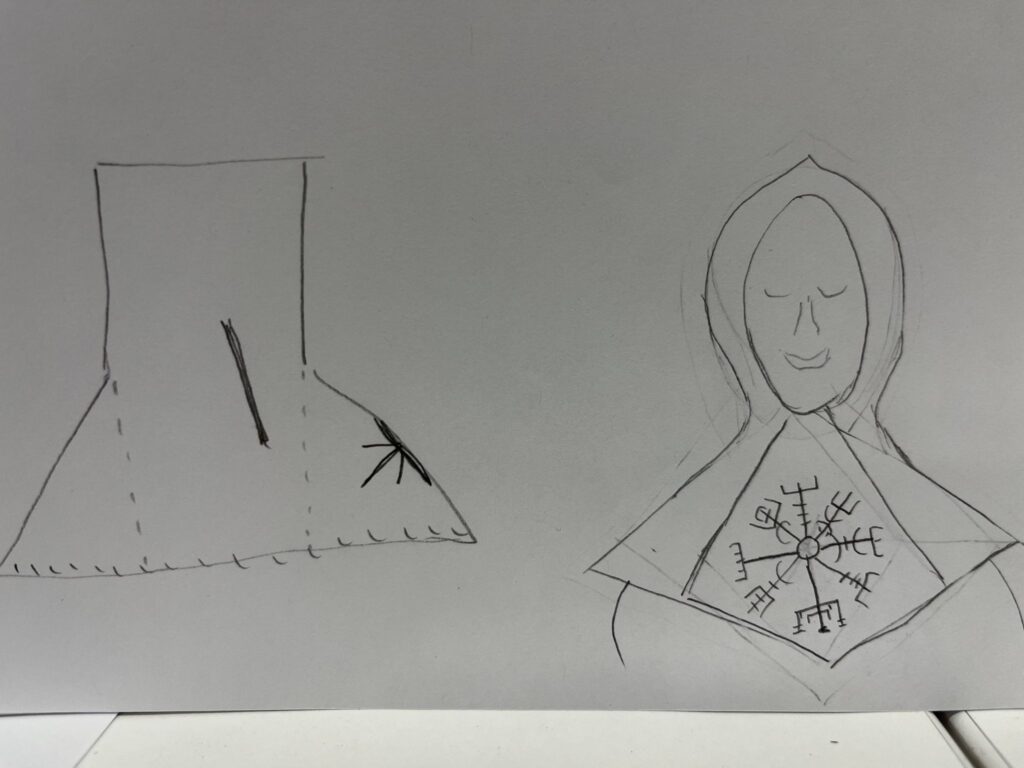
Ég er nýbyrjað á verkefninu, þannig að í bili færðu bara mynd af hráefninu mínu og skissuni minni.

In English:

I intend to write a post on the research for this piece of clothing, which is based on an actual find from an island in Norway called Andøya, near Skjoldehamn. It was found on a body which was found in a peat bog, and dug up by a farmer while cutting peat, and after numerous rounds of testing is currently believed to date to between 995 and 1029. The body was determined to be female, and there is a 20-30% chance that she was of Sami descent. So this piece of clothing is NOT Icelandic, but it is very likely to be “Viking era” appropriate. This is where the appropriateness of it for my whole Icelandic focus ends, as I am making it of materials that are only vaguely accurate (heavy wool from a blanket, lined with silk, and embroidered with wool) and in colours and with embroidery that is far more fantasy Viking-ish than historical.

I’ve just started the project, so for now, all you get is a picture of the raw materials and my sketch!

mjög spennandi! (very exciting!)

mjög spennandi! (very exciting!)

A couple of days ago, I finally figured out how to get all the content I’d written for this website back, when I’d previously thought it was all lost. I am absolutely thrilled to have done this, and to have all of the previously written content back up and running on my site.

But now I have to write a major caveat: most of the content on this site was written in 2017 and 2018. My life has changed significantly (and in a good way!) since then, so much so that some of the content on here makes me cringe a little myself. But everyone has to start somewhere, right? Even people with PhDs were at one time a brand new undergrad student who was probably nervous about their first day at college or university. So while I cringe a tiny bit, I am not embarrassed by anything I have on the site here; it just needs updating. And that will happen, just not right this second. I just ask that you take that into consideration when you’re reading things that were written a few years ago. But otherwise, enjoy!

Hvað er í gangi hérna? (What’s going on around here?)

Hvað er í gangi hérna? (What’s going on around here?)

Sæl gott fólk! Það hef verið mjög langur tími síðan ég hef skrifað hérna. Mig hefur lengi langað til að byrja að skrifað hérna aftur, en lífið mitt var mjög upptekinn. Það mun vera mjög upptekinn ennþá í næsta ári eða svo, en ég hef ástæðu til að vilja að þetta komi í gang sem fyrst, svo ég set þetta í forgang.

Svo… hvað er í ganga í lífið mitt? Hvar á ég að byrja? Guð minn góður. Jæja… ég er kominn aftur í háskólann. Og það er bein afleiðing af sumum athöfnum mínum sem ég hef talað um áður á þessari vefsíðu! Því miður held ég að ég geti ekki endurheimt fyrri færslur, svo ég verð að endurskrifa þær á endanum. Ég ætla að skrifa um þessa sögu annars staðar á þessari síðu, svo ég fer ekki út í allar upplýsingar hér. En já! Mjög spennandi! Aðalnámssvið mitt er íslensk tunga, bókmenntir og menning. Já í alvöru. Það er af hverju er ég að skrifa í íslensku hér. Ekki hefur áhyggjur… ég mun skrifa í ensku líka, eftir íslensku. Ég veit að mest af fólk sem er líklega að lesa þessi, líklega talar ekki íslensku. En ég þarf mjög rósalega að æfa mig með skrifandi, svo þessi er góður staðar að gera það.

Allavega, ég er búin að læra íslensku í fjögur ár núna, og ég er að byrja fimmti árið mitt. Ég byrjaði strax í kringum fyrsta ágúst í 2018, svo ég nota fyrsta ágúst sem afmælisdag. Ég lærði í tvö ár mestu á eigin spýtur, með hjálp frá vinkum og einstaka einkakennslutíma. Eftir um það bil ár sagði vinkona mín mér frá einhverju æðislegu. Hún býr í Winnipeg og það kom í ljós að það er svæði í Manitoba sem stundum er nefnt „Nýja Ísland“ vegna þess að það voru margir innflytjendur frá Íslandi til Kanada í lok 18. aldar og snemma á 19. áratugnum. Vegna þess er Háskólinn í Manitoba með heila íslenskudeild og kennslu í íslensku meðal annars tengdu efni. Auðvitað langaði mig strax að flytja til Winnipeg og fara á námskeið en það var ekki framkvæmanlegt. En þegar Covid byrjaði um átta mánuðum síðar þurftu allir háskólar að setja námskeiðin sín á netið og mér datt í hug að þessi myndi líklega fara á netið líka. Það gerði það og ég tók saman öll skjölin mín rétt í tæka tíð til að skrá mig fyrir skólaárið 2020/2021. Nú hlakka ég til að byrja þriðja árið mitt í september.

Ég er líka mjög spennt af því að maðurinn minn og ég ætla að flytja til Winnipeg næsta ára! Reyndar erum við nýkomin úr vikufríi í Winnipeg bara síðasta þriðjudag. Við forum að Winnipeg fyrir nokkrar ástæður. Fyrst fórum við að skoða Winnipeg og kanna hin mismunandi hverfi innan þess, þannig að þegar við förum að flytja höfum við hugmynd um hvar við viljum búa. Í öðru lagi vildum við fara á Íslendingadagurinn í Gimli, MB sem er aðeins klukkutíma norður af Winnipeg. Í þriðja lagi heimsóttum við háskólann í Manitoba, þar sem ég fékk skoðunarferð um Íslandsbókasafnið, og hittum nokkra úr íslenskudeildinni, þar á meðal íslenskukennarann minn! Það var SVO gaman. Þetta var líka í fyrsta skipti sem við höfðum ferðast eitthvað nýtt síðan Covid byrjaði og við þurftum báðar virkilega frí. Þetta var yndislegur tími og núna get ég varla beðið eftir að flytja. Ég held samt að næstu 9 mánuðir muni líða hratt, því við eigum SVO mikið að gera áður en við getum flutt.

In English…

Hello good people! It’s been a long time since I’ve written here. I’ve been wanting to start writing here again for a long time, but my life has been very busy. It will be very busy still for the next year or so, but I have reason to want it up and running as soon as possible, so I’m making it a priority.

So, what has been going on in my life? Where do I start? Oh my god. So… I’ve gone back to university. And that is a direct result of some of the activities I’ve talked about before on this website! Unfortunately I don’t think I can recover the previous posts, so I’ll have to rewrite them eventually. I plan to write more about the university story elsewhere on this site, so I won’t go into all the details here. But yes! Very exciting! My main field of study is Icelandic language, literature and culture. Yes really. That is why I’m writing in Icelandic here. Don’t worry, I’ll write in English too, after Icelandic. I know that most of the people who are probably reading this don’t speak Icelandic. But I really need to practice writing, so this is a good place to do it.

Anyways, I’ve been studying Icelandic for four years now, and I’m just starting my fifth year. I started right around the first of August in 2018, so I use the first of August as my anniversary date. I studied for 2 years mostly on my own, with help from friends and occasional private lessons. After about a year, a friend of mine told me something awesome. She lives in Winnipeg and it turns out there is an area in Manitoba that is sometimes referred to as “New Iceland” because there were many immigrants from Iceland to Canada in the late 1800’s and early 1900’s. Because of this, the University of Manitoba has an entire Icelandic department and courses in the Icelandic language among other related subjects. Of course, I immediately wanted to move to Winnipeg and take a course, but that was not feasible. But when Covid started about eight months later, all universities had to put their courses online and I figured this one would probably go online too. It did and I got all my documents together just in time to register for the 2020/2021 school year. Now I’m looking forward to starting my third year in September.

I am also very excited that my husband and I are moving to Winnipeg next year! In fact, we just got back from a week’s vacation in Winnipeg just last Tuesday. We went to Winnipeg for several reasons. First, we started exploring Winnipeg and exploring the different neighborhoods within it, so that when we move we have an idea of ​​where we want to live. Second, we wanted to go to the Icelandic Festival in Gimli, MB which is just an hour north of Winnipeg. Third, we visited the University of Manitoba, where I got a tour of the Iceland Library, and met some of the Icelandic department, including my Icelandic teacher! It was SO much fun. It was also the first time we had traveled somewhere new since Covid started and we both really needed a break. It was a wonderful time and now I can’t wait to move. I think the next 9 months will go by fast though, because we have SO much to do before we can move.

new translation: Uppruni Íslenskra húsdýra/Origin of Icelandic Domestic Animals, by Stefán Aðalsteinsson

new translation: Uppruni Íslenskra húsdýra/Origin of Icelandic Domestic Animals, by Stefán Aðalsteinsson

Note: Upon rereading this in September 2022, I’ve noticed that there are many issues with the English translation of this.  I’m going to re-translate it sometime in the near future, now that I actually speak the language to some degree, and know WAY more about the grammar and sentence structure etc. and have someone I can go to for help who has actually done translations professionally, as well.


This is a project that started because I wanted to find definitive proof that Icelandic Sheepdogs have existed in pretty much the same form since the Viking era.  I’m still working on THAT particular part of it, but that has since spawned a number of offshoot projects, including research on other animals, as well as learning to speak/read/write Icelandic.  (The latter was sparked by coming into a number of interesting pieces of research written in Icelandic at the same time).  This article was referenced by this page on the ISAA website, and I went in search of it.  I was unable to find a copy via inter-library loan within Canada, and in the end, I resorted to using the online help application on the website for the University of Iceland’s Library, and an extremely nice and helpful gentleman named Jóhann who works there scanned the article and sent it to me via email in PDF form.  I then set about translating it using my weird little method, and then my friend Sara proofed my translation and made a few small edits to make the translation clearer.  So here I present to you, my translation of Uppruni Íslenskra Húsdýra by Stefán Aðalsteinsson.  If you would like to see the original text, with all of the references to his source material, I have that as well, and you can download it here: Uppruni Íslenskra húsdýra final.  The spacing in this document is somewhat funny, as I have done it as a side by side comparison of the Icelandic and English, and I have tried to keep the paragraphs of each language next to each other. In some places, I have added translator’s notes for further clarification, and in these instances the English paragraph is much longer than the Iceland.  I suspect some future projects will be obtaining some of his sources and translating those.

Origin of Icelandic domestic animals, by Stefán Aðalsteinsson

Premises

The origin of Icelandic domestic animals can give some indications as to where the people came from who built Iceland in the past. From the lay of the land and the weather, it is believed that the first settlers sought to build their livelihood to a significant extent on livestock and brought it to their country from their homeland.

It is possible to discover the origin of domestic animals by various methods.  First we should consider the bones that have been found from the years the first settlers came in, both in Iceland and in the countries that the animals could be from.

Historical sources can indicate where our domestic animals might have come from. However, it should be noted that all stories from the settlement in Iceland and the early years of the country were written long after the settlement, and their direct validity is limited for this reason. However, descriptions of livestock from the time stories were first put down in writing can provide some information on how livestock came here, for example due to the relatively short amount of time from landing.

A comparison of the livestock foundations in modern Iceland and neighboring countries can also give evidence of the origin of Icelandic domestic animals. However, such a comparison must be done with caution because changes might have happened in livestock farms in Iceland and neighboring countries in the past eleven centuries.

In the neighboring countries, the breeding policy in the 18th and 19th centuries that grew up in a group of livestock communities, was to produce a uniform breed. This was called for to achieve a solid breed. For this reason, it is highly doubtful to use the external characteristics of livestock in modern times to judge the outer appearance of different livestock models because related livestock may have changed to different degrees of such a selection, and the distant related kinds have gotten similar in look and structure because of selective breeding in the same direction.

Icelandic farm animals may also have changed in the past decades and centuries from the way they were at the time of settlement. There are many attempts to import sheep and cattle to the country. It is also known that sheep, horses and cattle fell untouched in hard times in the early centuries. Likewise, it is known that in recent decades there have been major changes in sheep, cattle and horses in the past decades, as a result of targeted breeding.

The main way to avoid the effects of various types of comparison between livestock breeds is to choose for heritable traits that can not be judged by external appearance. Blood from the tract is often taken into account, and hereditary genes are found, such as blood type, egg whites and tissue groups.

The points outlined above need to be considered when attempting to draw a picture of the origins of Icelandic domestic animals.

Cattle

Extensive research has been conducted on the origins of Icelandic cattle. Information on cattle from ancient journals that may be helpful in tracing their origins is very scarce. However, referring to the colors of the bull Brandkrossa in Brandkrossa Þattur (this is the name of one of the Sagas – ed.) he drank milk in both winter and summer, but he was a pale pink color. The key is that the grip has a red base and dark cross sections in the areas that are reddish. Crossbones are called cattle that have a white color in the front that extends to the eyes and ears. When the white color returns to the eyes and back or over the ears, it is said that the grip is helmetlike (other color on the head than the rest of the body) or húfótt is another word for white colour on the head, helmet like.

Horned cattle were most common in the past, as the horns made cattle valuable. Hornless cattle have been in Iceland since ancient times. Pieces of skull from hornless cattle were found in a bone collection, which came from the excavation of a house at Aðalbóli in Hrafnkelsdalur valley. Skulls of hornless cattle were also found in the skeletal remains excavated in Stóraborg under Eyjafjöll. (Translator’s note: Stóruborg was an old manor town near the volcano Eyjafjöll in southwestern Iceland. It existed there from approximately the year 1000 until 1840, when it was moved 640m to protect it from the sea. Ref: Sunnlenskar byggðir IV).  Also, skulls of hornless cattle have also been discovered by excavation in the settlements of the ancient Greenlanders. Both indicate that hornless cattle were taken to Iceland during the settlement. In the 16th century, beautiful horned Icelandic cattle. However, there were a few hornless bulls in Iceland. At the beginning of the 19th century, cows in Iceland were mostly hornless, but there were many horned cows. This suggests that men had begun to choose intentionally for hornless calves beyond the 16th century. In the early 20th century, cattle in Iceland were very diverse in color and exterior appearance.

A few attempts were made to import Danish cattle to Iceland in the 19th century, but it was said that they had a minor effect on the Icelandic cow.

Two studies have been conducted on blood groups and egg white models in Icelandic cattle. In the previous study it became apparent that Icelandic cattle were closely related to old Norwegian landraces, ie. Þelamerkur, Dala and Þrændakúm. In this study, it was further noted that Icelandic cows completely lacked blood type genes that characterize Jersey cows. The speculation that Icelandic cows are to some extent derived from Jersey cattle is unsubstanstiated.

The latter study found that Icelandic cattle were closer to  Guernsey cattle, when compared to other European types, than the Norwegian ones. However, the genetic distance of Icelandic cow from Guernsey cattle was more than twice as much as the distance from Norwegian cows to Guernsey cattle.

Kinship with Guernsey cattle has not been observed in all studies. In the previous study of blood counts of Icelandic cattle, Icelandic cows were less related to Jersey cattle and Guernsey cattle than the other coworkers compared to those studies.

A scholarly assessment of Icelandic cattle’s relation to cattle in other countries stated that the relationship with the old Norwegian cattle was very close. If it were assumed that Icelandic cows were randomized samples from Norwegian cows during the settlements, the difference between a thorough assessment of Icelandic cattle’s relations with cattle from other countries was that the relationship with the old Norwegian cow was very close. If it were assumed that Icelandic cows were randomized samples from Norwegian cows during the settlements, the difference in modernity was no greater than that which could only be caused by settlement until 20th century.

Horses

Icelandic horses are different from other horses, as is best seen by how much attention Icelandic horses have attracted overseas in this century.

Ancient stories tell you about famous horses. A female horse named Fluga, who came with a ship that landed at Kolbeinsárós (translator: a trading post at the mouth of the rivers Kolka and Hjaltadalsá), was the fastest of all horses. Hauknefur in Gotland gave Gull-Þóri Kinnskæ, a dark red horse who was a gauskur (Swedish) runner and was fed in winter and summer on grain. Freyfaxi Hrafnkels Freysgoða was pinkish in color according to the most widely used script of Hrafnkel’s story. In older versions, he was said to be brown. He was the cause of great events.

Studies on Icelandic horse bones from pagan graves indicate that Icelandic horses are very similar to Norwegian horses as they were before Iceland’s settlement. They also resemble horses from 6 to 8th century in Beckum in Germany. However, Icelandic horses have been smaller at the time of settlements than the German and Norwegian horses that they were compared to. Horse bones have also been found in Greenland that are very similar to ancient bones from Icelandic horses.

Icelandic horses have been known for a long time for their light-footed gait. It has been mentioned that horses that could both tölt and skeið (Translator: the tölt and skeið are both gaits that the Icelandic horse has – the Icelandic horse has 5 gaits, instead of the 4 that most horses have) have been eradicated in mainland Europe by using horses for wagons to a greater extent than before. Trotting worked better.

The Nordland horse from Norway is considered the forefather of the Icelandic horse. Is then judged by external appearance, facial appearance and character. Blood group research, however, indicates that the Icelandic horse is more related to the Shetland horse, than the Nordland horse and the Fjord horse in Norway. It is not surprising because Hjaltland (Shetland) was a Norwegian territory for hundreds of years, so it was unlikely that men had taken horses from Norway when Norwegians started settling there. It is surprising, however, that Icelandic horses are not very  related to the Norwegian Fjord horse. The most reasonable explanation for this is that the Fjord horse has changed significantly since the settlement.

Horses were cars on land in the past. As transportation on land grew easier, the movement of horses between countries grew ever greater. Horses, however, have barely been transported between countries during the peace period. Horse exchange and horse buying were an easier solution and must have been known as now. In the wars horses played a different role. Vikings who attacked England from mainland in 892 had horses aboard their ships. Ólafur Tryggvason and Sveinn Tjúguskegg attacked London in September 994, but were driven out and suffered great losses. Then their army returned on horseback and went far into the land and did a lot of damage (bál og brand is a saying in Iceland, meaning a lot of damage)

There has been no reason to import horses from other countries to Hjaltland and Iceland later in the settlement era and horses had become commonplace.

Sheep

Sheep have been in Iceland since the settlement, but no sources are available regarding where they came from. The Icelandic sheep is from Northern European short-tailed sheep. They are in Iceland, the Faroe Islands, Shetland and Orkney, Norway, Sweden and Finland. The sheep of this kind have a short tail or “dindil” (the word we use for a short tail on the sheep) and the wool of this sheep is usually found in two forms, the rough tog and fine thel. In Finland, Sweden and Norway, it is common for both sexes to be unhorned, but also for both sexes to be horned. Four horned sheep occur in Sweden and are considered to occur in Norway but is very rare. In the Faroe Islands, Hjaltland and Orkney, rams are usually horned and females hornless. It occurs in free range sheeps on the island of Soay (Sauðey) in Scotland and in the UK’s long tailed breed, and more in sheep breeds in southern part of the continent, such as merino in Spain.

In Icelandic sheep, both sexes can be horned or the female can be hornless (kollóttar) or hnýflóttar (a horn that stands straight up like a finger and is usually short on females), and the males can be hornless (kollóttir),  örðóttir (a horn that can be felt under the skin but has not broken through, or has broken through but is very short), hnýflóttir (a horn that stands straight up like a finger and is usually short) or sívalhyrndir (when the horns are round, like the typical ram pictures).

It is not common that the rams are horned and the ewes are hornless.  This alone is in fact sufficient proof that Icelandic sheep come from the Nordic region. When color is taken into account, it is still possible to narrow the area. The colors of Golsótt and Botnótt are found in the Norwegian short tailed sheep and on Icelandic sheep. (Translator’s note: Golsótt is when the underfleece is white and the longer hair is black/grey, but the stomach is usually white or black, and Botnótt is when the stomach to the butt is white and rest of the body is a darker colour, are the names for special fleece colours in Icelandic sheep). In both genders, the Icelandic model is of gray and in both genders there is a black and dark red color. Norway has more solidarity with Icelandic sheep in colours and types of horns than any other sheep breed in the Nordic region. In addition, there is a good match between these sheep breeds in hereditary hemoglobin and blood potassium. Accordingly, Icelandic sheep come from Norway.

Goats, pigs and dogs

Goats came here during settlement. They are mentioned in ancient stories, and many place names are associated with goats. (örnefni can be nickname for places, and also nickname for people, but in this instance they are referring to place names). Nothing can be said concretely about the origin of Icelandic goats but going by the colors and horns they resemble Norwegian goats.

Pigs were brought to Iceland during settlement. They are mentioned in stories and many place names are associated  with them. Pigs still existed in Iceland in the latter part of the 16th century, but died out in the 17th century.

Two types of dogs seem to have been brought to the country during settlement. One of them is of an average size, but the other is much larger. Bones of the larger species have been discovered in Greenland, and have been similar to Irish Wolfhounds. It is tempting to associate that finding with the story of Sámi that Olaf was given in Ireland, and later he should have given Gunnari on Hlíðarenda.

Hunting dogs that were much larger than other dogs were in Iceland in the 16th and 18th centuries but appear to have died out late in the 18th century. They may have all been put down in the Mist Hardship. (Translator’s Note: a famine which occurred after the eruption of the volcano Laki in 1783/84 which lasted for 8 months and killed many people and animals)

Blood tests that have been carried out on the Icelandic Sheepdog, which have been bred here in recent decades, indicate that they originate from the Nordic countries.

Cats and mice

Cats have been brought to Iceland in the early centuries, ie. during settlement. The cat belly was a commodity of ancient times, and the belly of a male cat was worth the equivalent of three autumn lambskins. Studies on the color genes in cats in Iceland and neighboring countries show that the Icelandic cat is closely related to cats in Sweden and in the Shetland Islands, but distant related  to cats in Ireland and in South England.

Mice in Iceland are field mice. They enter houses during the winter, but move into the pasture during the summer. Characteristics of mouse skulls indicate that field mice had been brought to Iceland from Norway, from which mice would also have been sent to Shetland and the South Tyrol. Blood type studies did not give a clear answer to where the Icelandic mice had come from.

Studies on parasites on the Icelandic mouse have revealed that they are a species of flea that is found only in continental Europe. Mice in the British Isles have another type of this flea. The differences show that the Icelandic field mouse does not come from the British Isles, and the skull leads strongly to the mice coming from Norway.

A further article has been drawn up for the origin of Icelandic domestic animals in other areas and is referred to.
reassembling…

reassembling…

It would appear that at some point, the database running my website got nuked.  Please pardon the dust while I try and put things back together around here!  I’m hoping I can get a fair bit of my old content out of the wayback machine, since I was silly and didn’t keep copies of what I’d written on my local drive.

Coming soon… new research on animals in Iceland, pictures of my puppy who is almost all grown up now, and 10 new Icelandic chicks that I’m raising!

Ása the Norsk Elghund: a story written in persona

Ása the Norsk Elghund: a story written in persona

The year is 913. My name is Guðrún, and I am a farm wife living in the north of the island called Iceland. I am in my mid 40s, and I was born in Norway, but many years ago, when I was newly a woman, my husband and I packed up our belongings and set out to seek a new life. We sailed west with some other folk, and after a short voyage, thanks to favorable winds, set our feet on land again near the place called Húsavík. We built a farm near where our ship landed, and we have lived there ever since. We make our living raising sheep and goats, and I make beads from glass, and every summer, my husband Björn joins a group of other men to go a-Viking.

Caring for our farm is hard work, especially because the gods did not see fit to bless us with children. Every other woman around seems to have given her husband least a few sons to be his heirs, but I was not blessed the same way. My mother always said I was very sick as a little baby, so maybe that’s the reason. I certainly have made all the appropriate offerings to the gods, so I can’t imagine they are mad at me. I suppose it was a blessing in disguise, since it meant fewer mouths to feed, and we did not have to watch any children die when they were babies, but with just two of us to work our farm, and Björn often gone for the summer months, it made for much more work for me. Fortunately one of our closest neighbours had many, many children, and we were able to get a bit of help from them in exchange for wool and milk.

Ever since I was a little girl, I have always loved animals. My mother would often find me in the fields with the sheep and the goats, and at night our farm cats and hounds would all pile into my bed with me, as I was an only child. So it was to no one’s surprise that when Björn and I left for Iceland, we brought many animals with us. In addition to the sheep and the goats, we of course have many cats around our farm to keep away the mice and the rats, and I keep chickens for the eggs and meat, and we have always had a dog or two around as well. I have found that with many animals around, the heartache from never having children of my own has lessened over the years, and I dote on my animals like others would a child. Of course, as a húsfreyja I was given cats when we first established our household, as any good farm wife would want cats to keep the mice away, but I always seem to have more around me than most other women around.

This year, Björn and his friends that he would usually spend the summer a-viking with, decided that instead of going raiding, that this summer they would venture back to Norway, to visit friends and family there. Word had passed to us Björn’s father was getting very old and sick, and it might not be long before he made the passage to Valhalla. He had never died in battle, but had survived many of them and would surely be chosen to join Odin when he passes. Björn decided he wanted to make the journey to try and see his father one last time. And besides, there are no bees in Iceland, and our kegs of mead were all but depleted, and what would the men do without their beloved mead? Of course, as someone needed to stay to take care of the farm, I wasn’t able to join him on his journey.

Shortly before Björn’s ship set sail, we suffered a great loss here on the farm too. Our old dog, Snorri, who we knew was not a young pup anymore, as he had been with us for many years, had been slowing down, and had been making sounds that told us his joints were stiff and hurting, for a while now. Finally the time came where his body just couldn’t keep going, and he went to wait for us in the afterlife. It was a very sad time for us, and hard, but time stops for no one and so we had to continue on with our lives, taking care of our farm and our other animals. But the loss of our close shadow, for Snorri always seemed to be no more than a few feet away from one of us at all times, left a vast hole in our hearts.

So as I said earlier, Björn made the trip back to Norway, and by his telling, the trip was as easy as ours was when we first came to Iceland. He was able to see his father, and be there for him when he passed, and give his mother comfort, and of course replenish our mead supply. He also did return with supplies for the farm, and gifts for me, as he often does when he is gone for a period of time. This time he returned with a little green stone, carved in the shape of a dog just like our Snorri, with a loop so that it can be hung around one’s neck, and a beautiful white fox fur, and some grains for planting next spring… but none of those compare to the final gift he gave me.

While he was visiting his family, Björn happened on a local man who greatly enjoys hunting with a bow and arrow, who also raises dogs to hunt with him. It just happened that one of this man’s bitches had recently had a litter of puppies, and my husband thought that would be a suitable gift to bring home for me. He certainly knows me well, my husband does. It was the best present he could have possibly brought me. I named her Ása, and she’s been with us for a month now. She’s just three months old, and a little bundle of mischief. But when she finally stops jumping at my side and nipping at my heels, she’s her Mama’s little baby.

(((Out of persona aside: we lost our old dog, Cody, to old age and arthritis in mid-August, and we miss him dearly. As luck would have it, someone in our area posted a litter of Norwegian Elkhound puppies on the local classifieds that would be ready to go in early September. Well, being one of our top choices for dog breed, and pretty much perfect for my persona, there was not much hesitation in putting a deposit on a new puppy to join our family. She turned 8 weeks on September 4th, and came home on September 6th. And her name really is Ása, which is a name which can be documented to the Viking era, as it was found in the Landnámabók, the Icelandic Book of Names. Documentation is available here:http://www.ellipsis.cx/~liana/names/norse/landnamabok.html.  The name Ása is pronounced “Ow-sa”, where the “ow” is like the sound of the ou in the word ouch.  However, because we got Ása before I started learning the Icelandic language, we originally pronounced her name with the Á as the sound of a long A – for anyone who speaks Icelandic, like the sound the letter combination “ei” makes.  I now alternate between the two so she responds to both, but my husband refuses to change his pronunciation. )))

Íslenska Sauðkindin: Icelandic Sheep

Íslenska Sauðkindin: Icelandic Sheep

a photo of three Icelandic sheep

I’ve actually been a spinner for a lot longer than I’ve been interested in all things Icelandic. Up until now, however, I’ve never worked with the fleece of an Icelandic sheep. I started planning this particular project before I decided to focus on Iceland and have an Icelandic persona, so it’s a bit of a happy coincidence that this project fits in quite nicely with my overall goal here. I decided a few years ago that I wanted to do a sheep to dress project – going from raw fleeces, straight off the sheep, and do every single step along the way myself, by hand, as close to the way it would have been done in the Viking age, and ultimately end up with an apron dress for myself. The first step in this project was to research breeds of sheep to find the right one, and as I did have a Viking era persona at that point, even if it wasn’t Icelandic at the time, I came to the conclusion that the Icelandic sheep was probably the closest to what would have been available in the Viking era. There are a few other breeds that would also have worked – the Soay, the Norwegian Spaelsau, and the Jacob, for example – but for some reason I decided on Icelandics. As it turned out, that was a good choice for me since a few years later I decided to narrow my focus to Viking-era Iceland! Icelandic sheep are directly descended from the sheep brought to Iceland by the people who settled it.

The Icelandic sheep is a Northern European short-tailed sheep which has a double coat.  They have a soft inner coat called the thel, and a coarser, longer outer coat called the tog.  When the two are mixed together during carding and spinning, they can make a yarn which is very stable while still being able to be spun fairly thin, called Lopi.  This yarn is best used for outerwear, though, as it’s not super soft and fine like Merino or wools like that.  Alternately, the tog and the thel can be separated with wool combs (or by hand) and spun separately.  The tog spun by itself will produce a softer yarn, and the thel will make a coarser (and I suspect more waterproof) yarn.  I will be doing some experiments with a small portion of the fleeces I get, to decide whether to separate the tog and thel, or to spin it together.

My project got put on hold for a while over the past couple of years, because I was struggling to get my hands on some Icelandic fleeces, for a few different reasons – but the main one being finances. I have not been able to find anyone in my immediate area who keeps Icelandic sheep, which meant either having the fleeces shipped to me, or going out of area to get them. While fleece is too heavy, unless you’re getting a lot of it, it is quite bulky, and would not be cheap to ship. Fortunately, I realized that the site for June Coronation is only a couple of hours from Biggs Ranch, a farm in central Alberta that raises just about Icelandic everything… sheep, horses, chickens, and dogs. They’ll be shearing their sheep sometime between now and the end of June, and I’ve made arrangements to make a stop there on my way to Coronation to pick up some fleeces. I’m hoping to get going early enough in the morning that I’ll have time to meet their dogs (they have new puppies that were born in the past few weeks too!) and take some photos for my project as well.

So now that I FINALLY have fleeces coming, it’s time to get going on researching, building, and documenting the fibre prep tools I’ll be using! First up: wool combs based on the Oseberg ship find.

Photograph of Icelandic sheep by Andrea Schaffer, used with permission under a Creative Commons license, and found posted on Flickr at https://www.flickr.com/photos/aschaf/4825883771/in/photolist-8mrV7B-8mrR3V-8msA9c-8msAPH

Planting a Viking Garden

Planting a Viking Garden

Earlier this spring, it occurred to me that another good way to Viking up my life and home would be that when I’m planting the garden I was planning to plant anyways this spring, to make sure I planted as many things that the Vikings would have eaten fresh, as possible. So I did a bit of reading earlier this year, so that I could order seeds from a specialized merchant, if there were things I needed that I didn’t think I could find at the nursery. It turned out there were a fair few of these, since I was looking at herbs as well as vegetables, so it was a good thing I planned well ahead.

As it turns out, there is someone who has already written an article that did most of the research for me on this. So I will start by saying I relied fairly heavily on, and must give major credit to The Plants Used in a Viking Age Garden A.D. 800-1050 by Mette Eggen.

From the list provided in that article, I will be planting: Onion, Cabbage, Turnip, Peas, Beans, and Cress. The last 6 plants in the list I did not plant – Hemp, Flax, Woad and Hops are not plants used for eating (ok, yes, you can eat flax seeds, but it’s much more frequently used for pressing for oil, or to make linen), and apples and plums are, of course, tree fruit. Apples and plums I can readily buy at the grocery store in the summer, I can get them from the farmer’s market, or from friends who have an abundance. If I’m lucky, and the people who bought the empty lot next door haven’t chopped the trees down by the time they produce fruit, this summer I could even get some from the trees next door.

The first plant in the list, Angelica, is an herb that grows wild in Iceland, and it is native to Europe and Asia, but is not found in my area of Canada. it has been found on the eastern coast of Canada1, where is has been deemed an invasive weed. Given the fact that the Vikings are known to have landed in Canada around the year 1000, at sites like L’Anse aux Meadows2, I can’t help but wonder if it was brought over by the Vikings. This is pure conjecture on my part, however, and I have no evidence for this (yet. It merits further research though, I think!) I did order seeds for Angelica, but because it is difficult to germinate, I also ended up ordering some seedlings to be shipped to me.

I did do further research on my own, and to this list I have added:
Carrots (which wouldn’t have been orange, I am certain of that, but I’m not sure what colour they would have been)
White Mustard
Mint
Strawberries
Thyme
Mallow
Caraway
Coriander
Dill
Lamb’s Quarters
Stinging Nettle (I can get this wild here, in fact I think I’ll just be transplanting some from a friend’s yard)

Things the Icelanders grew which I am not growing, because they require too much land and are readily available in the store:
Barley
Wheat
Garlic (not because of the land use, but because it requires planting in the fall and I didn’t)

There are also a bunch of medicinal herbs that I am going to grow (most are still in seed form), but I will save those for another post. Right about now is the time to be getting things planted where I live, so that’s what I’ll be doing in the next week!

1. https://web.archive.org/web/20110927054751/http://www.natureconservancy.ca/site/News2?page=NewsArticle&id=13554&news_iv_ctrl=0&abbr=at_ncc_
2. Wikipedia page about L’anse aux Meadows